Artificial Intelligence

Human language
Online chatbots use natural language processing (NLP) to analyze poorly typed or spoken questions, then predict which answers to give on topics ranging from shipping or business hours to merchandise and sizes.
Vision recognition
AI helps doctors identify serious diseases based on unusual symptoms and early-warning signs, and it reads speed limit and stop signs as it guides cars through traffic.
Fraud detection
AI analyzes patterns created when thousands of bank customers make credit card purchases, then predicts which charges might be the result of identity theft.
Levels of AI
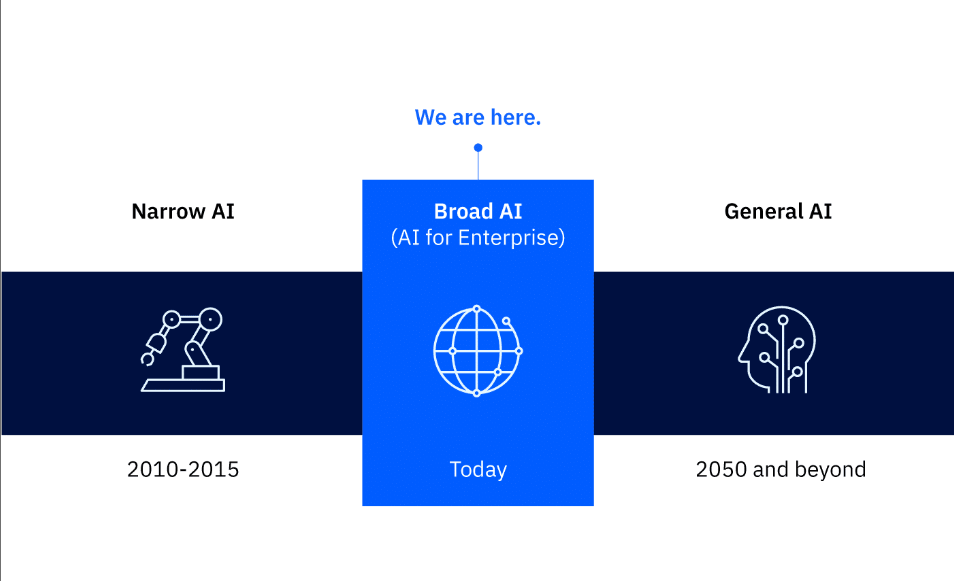
Computer scientists have identified three levels of AI based on predicted growth in its ability to analyze data and make predictions. They call these levels:
Narrow AI
Broad AI
General AI
Narrow AI
Narrow AI is focused on addressing a single task such as predicting your next purchase or planning your day.
Narrow AI is scaling very quickly in the consumer world, in which there are a lot of common tasks and data to train AI systems. For example, you can buy a book with a voice-based device.
Narrow AI also enables robust applications, such as using Siri on an iPhone, the Amazon recommendation engine, autonomous vehicles, and more. Narrow AI systems like Siri have conversational capabilities, but only if you stick to the script.
Broad AI
Broad AI is a midpoint between Narrow and General AI.
Rather than being limited to a single task, Broad AI systems are more versatile and can handle a wider range of related tasks.
Broad AI is focused on integrating AI within a specific business process where companies need business- and enterprise-specific knowledge and data to train this type of system.
Newer Broad AI systems predict global weather, trace pandemics, and help businesses predict future trends.
General AI
General AI refers to machines that can perform any intellectual task that a human can.
Currently, AI does not have the ability to think abstractly, strategize, and use previous experiences to come up with new, creative ideas as humans do, such as inventing a new product or responding to people with appropriate emotions. And don't worry, AI is nowhere near this point.
Think of tabulation as “slicing and dicing” data to give it a structure
Data is raw information. Data might be facts, statistics, opinions, or any kind of content that is recorded in some format. This could include voices, photos, names, and even dance moves!
Data can be organized into the following three types.
Structured data is typically categorized as quantitative data and is highly organized. Structured data is information that can be organized in rows and columns. Perhaps you've seen structured data in a spreadsheet, like Google Sheets or Microsoft Excel. Examples of structured data includes names, dates, addresses, credit card numbers, stock information.
Unstructured data, also known as dark data, is typically categorized as qualitative data. It cannot be processed and analyzed by conventional data tools and methods. Unstructured data lacks any built-in organization, or structure. Examples of unstructured data include images, texts, customer comments, medical records, and even song lyrics.
Semi-structured data is the “bridge” between structured and unstructured data. It doesn't have a predefined data model. It combines features of both structured data and unstructured data. It's more complex than structured data, yet easier to store than unstructured data. Semi-structured data uses metadata to identify specific data characteristics and scale data into records and preset fields. Metadata ultimately enables semi-structured data to be better cataloged, searched, and analyzed than unstructured data. An example of semi-structured data is a video on a social media site. The video by itself is unstructured data, but a video typically has text for the internet to easily categorize that information, such as through a hashtag to identify a location.
Machine learning solves problems in three ways:
Supervised learning
All supervised learning algorithms need labeled data. Labeled data is data that is grouped into samples that are tagged with one or more labels. In other words, applying supervised learning requires you to tell your model:
What the key characteristics of a thing are, also called features
What the thing actually is
Unsupervised learning
In unsupervised learning, a person feeds a machine a large amount of information, asks a question, and then the machine is left to figure out how to answer the question by itself.
Reinforcement learning
Reinforcement learning is a machine learning model similar to supervised learning, but the algorithm isn’t trained using sample data. This model learns as it goes by using trial and error. A sequence of successful outcomes is reinforced to develop the best recommendation for a given problem. The foundation of reinforcement learning is rewarding the “right” behavior and punishing the “wrong” behavior.
Key points to remember
Artificial intelligence refers to the ability of a machine to learn patterns and make predictions. AI does not replace human decisions; instead, AI adds value to human judgment.
AI performs tasks without human intervention and completes mundane and repetitive tasks, while augmented intelligence allows humans to make final decisions after analyzing data, reports, and other types of data.
The three levels of AI include: Narrow AI, Broad AI, and General AI. Narrow AI and Broad AI are available today. In fact, most enterprises use Broad AI. General AI won’t come online until sometime in the future.
The history of AI has progressed across the Era of Tabulation, Era of Programming, and Era of AI.
Data can be structured, unstructured, or semi-structured.
Structured data is quantitative and highly organized, such as a spreadsheet of data.
Unstructured data is qualitative data that doesn't have structure, such as medical records. It's becoming increasing valuable to businesses.
And semi-structured data combines features of both structured data and unstructured data. It uses metadata.
About 80% of all the data in today’s world is unstructured.
Machine learning has advantages compared to programmable computers. Machine learning can predict and machine learning learns!
Machine learning uses three methods.
Supervised learning requires enough examples to make accurate predictions
Unsupervised learning requires large amounts of information so the machine can ask a question, and then figure out how to answer the question by itself.
Reinforcement learning requires the process of trial and error.
With AI everywhere, AI will move into all industries, from finance, to education, to healthcare.
AI can increase productivity, create new opportunities, provide deeper insights, and enable personalization.